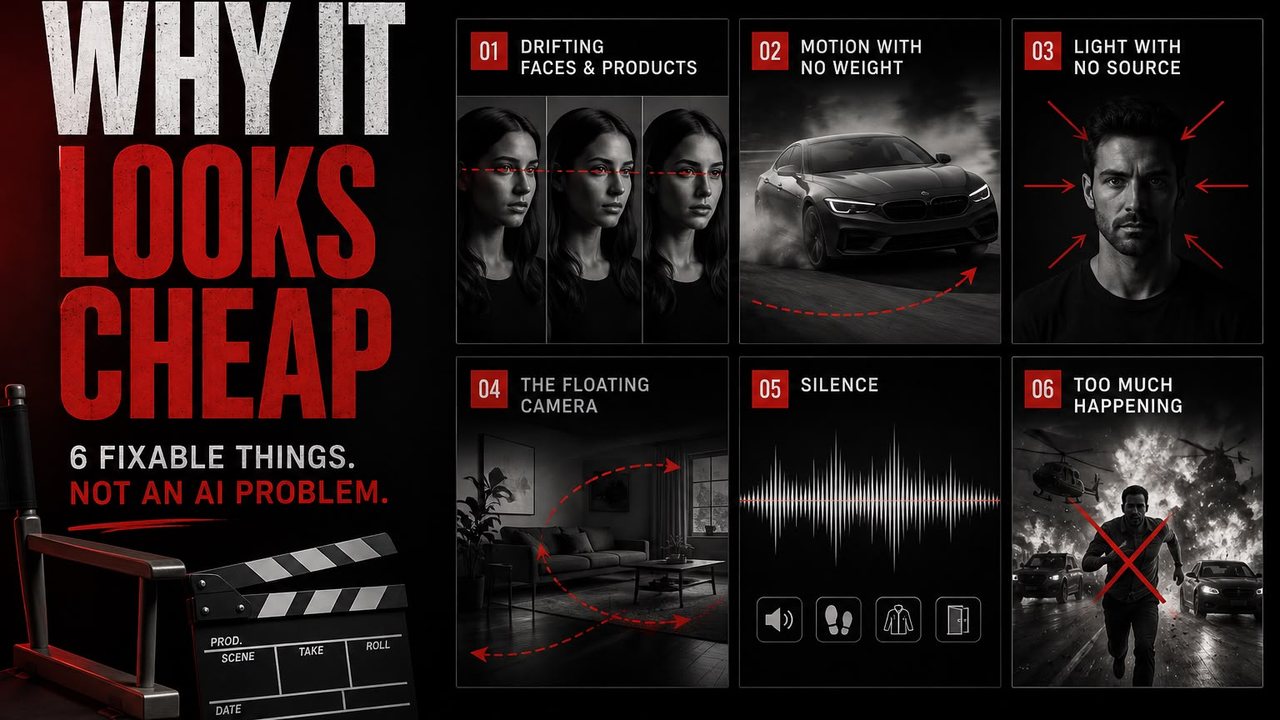
Audiences rarely say “that was AI.” They say it looked cheap. Usually they are reacting to one of six specific, fixable things.
Drifting faces and products
A character whose face subtly changes between shots reads as wrong even to a viewer who cannot name why. The same is true of packaging: if the label redraws itself, the product stops feeling real. The fix is preparation — turnaround sheets for people, locked references for products, and an explicit review pass looking only for drift.
Motion with no weight
Cloth that does not settle, hair that moves without inertia, a car that turns without transferring weight. Where a shot needs physics to be convincing, it is usually better to shorten the shot, change the angle, or cut on the movement than to fight for a longer take.
Light with no source
In a well-shot frame you can point at where the light comes from. Weak generated frames are lit from everywhere at once. Specifying a direction and a quality — hard key from camera left, practical behind the subject, bounce filling the shadow side — makes an immediate difference.
The floating camera
Slow, aimless drift on every shot is the most recognisable tell in the medium. Real coverage has static frames, motivated moves and cuts that happen because the story needs them. A locked-off shot with good composition beats a drifting one nearly every time.
Silence
Under-designed sound makes even good images feel thin. Room tone, footsteps, cloth, distance — sound is where a large amount of realism is manufactured, and it is the cheapest quality upgrade available on any project.
Too much happening
Long, complex actions inside a single shot are where errors accumulate. Films hold together better when each shot does one thing. That is not a limitation of the tools so much as ordinary film grammar, which most generated content ignores.
None of these are solved by better models. They are solved by treating the work as direction — which is the whole argument for hiring a studio rather than a subscription.