Guides
AI backgrounds vs location shoots: how they really compare
On cost, speed and control, generated backgrounds win most briefs. On anything you have to prove is real, a location shoot still wins. Here's how we choose.
Generated backgrounds win most ad briefs on cost, speed and control. A real location wins whenever the place itself is the claim, or a real person has to stand in it. The honest answer is that good studios use both, and the brief decides which.
Here’s how the two actually compare, and how we pick between them.
How do AI backgrounds compare with a location shoot?
An AI-generated background is built during production instead of being filmed on location, so it removes the travel, permits and shoot day while keeping full control over light and framing. A location shoot captures a real place as it is. For most product and brand ads the generated route is faster and cheaper; for briefs that have to prove a real place, the shoot still wins.
| Generated background | Location shoot | |
|---|---|---|
| Cost driver | Direction and post | Travel, permits, crew, the day |
| Time to a first look | Hours | Days to weeks |
| Control of weather and light | Total | Whatever the day gives you |
| Proves a real place | No | Yes |
| Biggest risk | Keeping details consistent | Weather, logistics, budget |
What do generated backgrounds do better?
Generated backgrounds beat a location shoot on four things: they cost less because there’s no travel or permit, they’re faster because there’s no shoot day, they give exact control over the weather and the time of day, and they make physically hard shots possible without a rig. None of that needs a booking.
- Cost. The money that a shoot spends on locations, permits, travel and catering simply isn’t spent. It moves to direction, motion and sound instead.
- Speed. You can see a coast road at golden hour tomorrow, not after a recce and a permit.
- Control. Rain, dusk, an empty street at noon: you set the conditions rather than wait for them.
- Reach. A tracking shot at speed or a slow pour needs no high-speed rig. Our Lamborghini Revuelto film was made in three days with no car on set.
When does a real location still win?
A real location wins whenever the footage has to prove something true. If the ad says “this is our store” or “our factory”, the place has to be filmed. The same holds when a specific real person must appear, when it’s a live event, or when a platform or a regulator wants evidence that the scene is real.
- The place is the claim. “Come to our showroom” needs your showroom, not a generated one.
- A real person must be in it. A founder, a real customer or a contracted face should be filmed as themselves. We won’t fake a real person.
- It’s live. A launch, a match or a wedding as it happens has nothing to generate.
- Someone could ask you to prove it. India’s ad code, set by the Advertising Standards Council of India, expects ads not to mislead. If a claim rests on a real place or a real result, keep footage that shows it.
We’d rather say this plainly than win the wrong brief. If your ad depends on proof, book the shoot.
Does a generated background look real enough?
For product, commercial and story-led ads on Meta and YouTube, yes, as long as the studio directs every shot and checks the product against its real artwork. The weak point isn’t sharpness. It’s consistency: a label, a bottle shape or a skyline can drift between shots, so each frame with your product in it gets checked before delivery.
That one check is the difference between a background that sells and one that quietly looks off. It’s also why “we’ll just generate it” isn’t a plan. Someone still has to direct it.
How do we choose for your brief?
We start from what the ad has to prove, not from the tool. If the setting is a mood, we generate it. If the place is the claim, we shoot it, or film the real thing and extend it. The script and shot list are approved before anything is produced, so the plan is set before the budget moves.
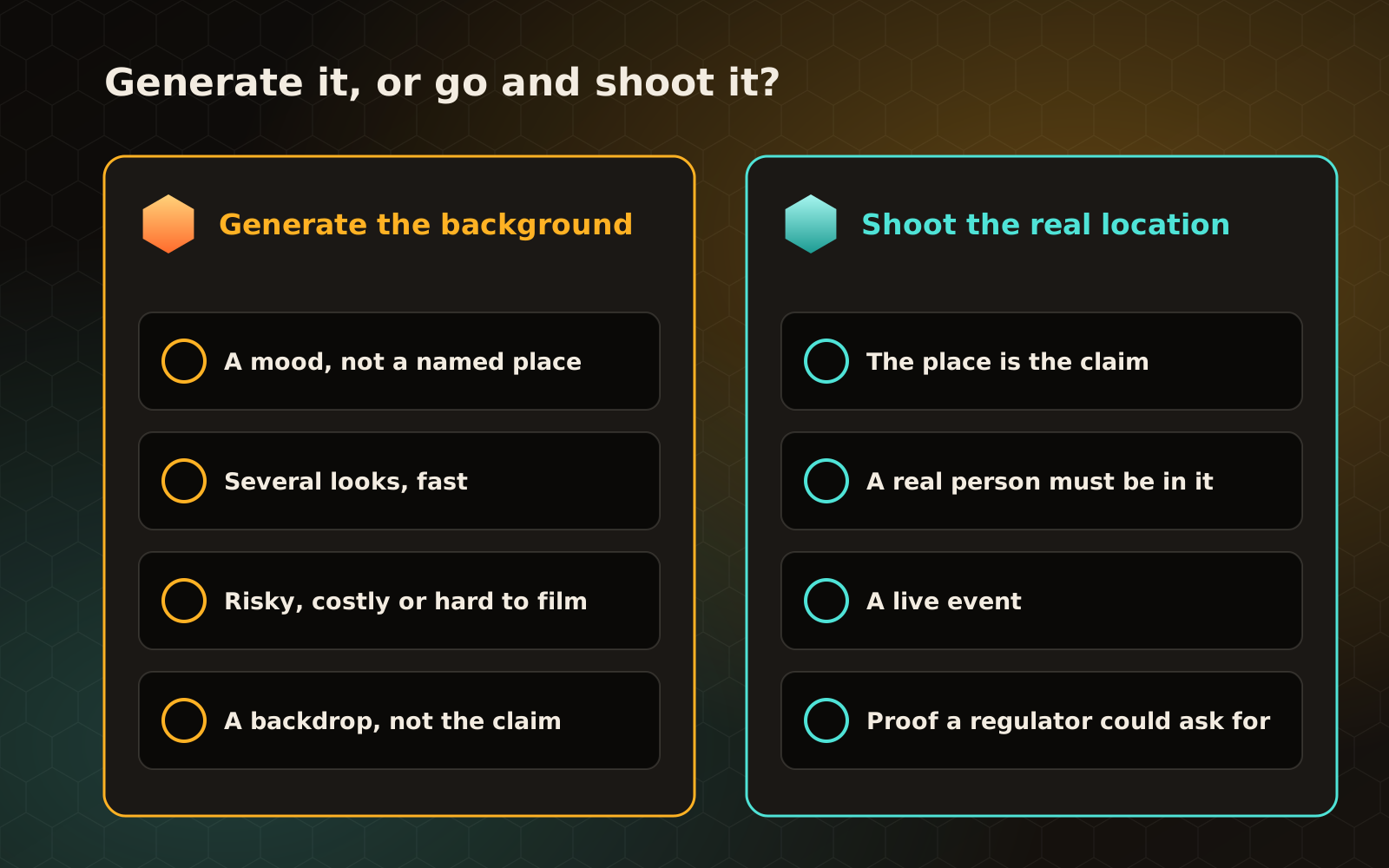
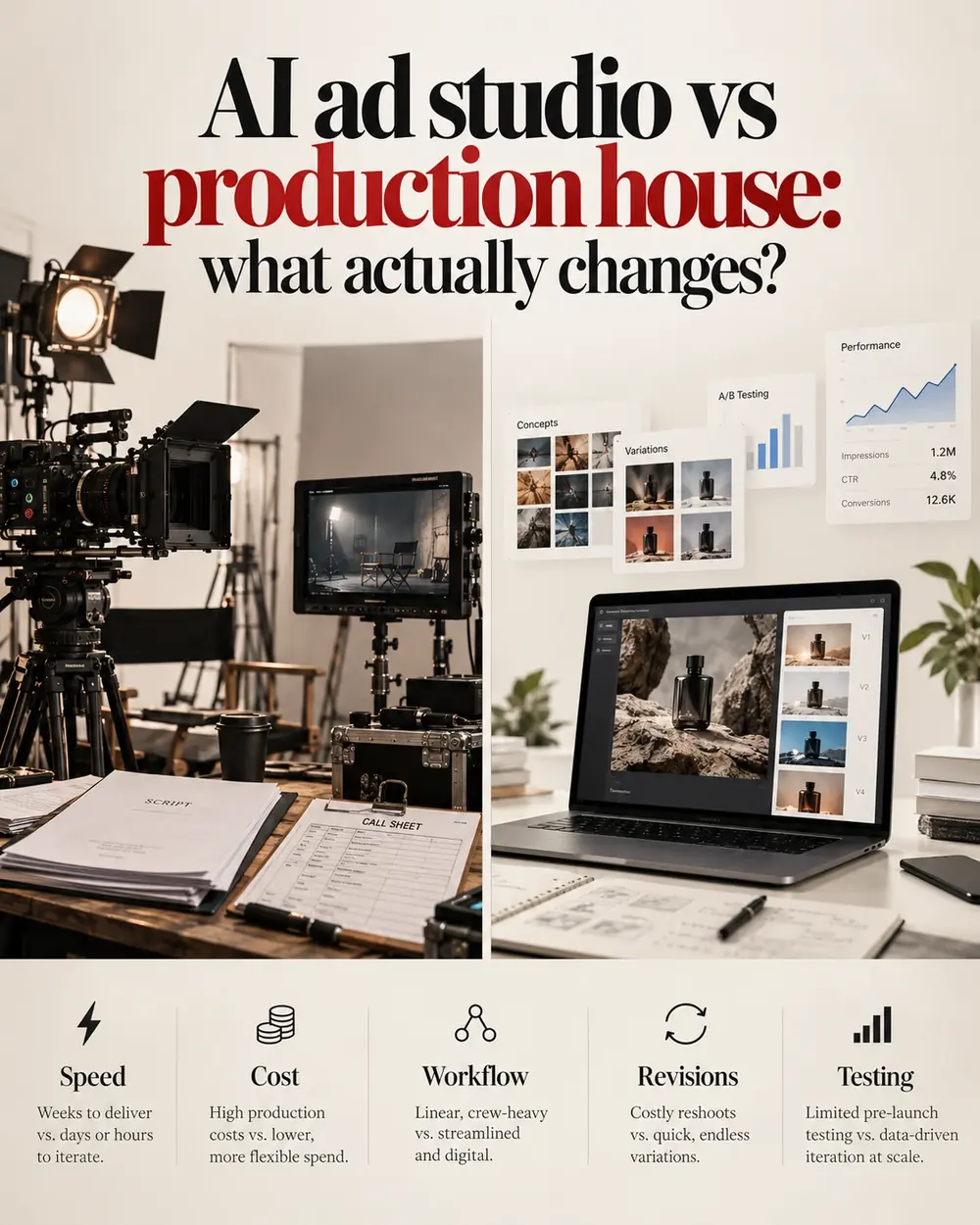
The two routes meet more often than either camp admits. Conventional shoots already use set extensions and clean-up; AI-led work already uses real product photography and recorded voices. For the wider comparison across a whole project, read AI ad studio vs production house, see what a job costs in our guide to AI video ad prices in India, or look at how this plays out in commercial ads and product ads.
Not sure which your brief needs? Send it to us and we’ll tell you honestly whether to generate the background or go and shoot it.
Frequently asked questions
Are AI-generated backgrounds cheaper than a location shoot?
Usually yes. A generated background has no travel, permits, crew call or shoot day, which is where much of a location budget goes. The saving is real but not unlimited, because the direction, motion and sound still have to be made.
Can an AI background replace a real location?
For most product and brand ads, yes. It cannot replace a location when the place itself is the claim, when a real person must appear in it, when it is a live event, or when a platform or regulator needs proof the scene is real.
Do AI-generated backgrounds look fake?
Not when each shot is directed and checked. The weak point is consistency, not sharpness: a skyline or a label can drift between shots, so every frame with your product in it is checked against your real artwork before delivery.
When should I still shoot on location?
Shoot on location when the footage has to prove something true: your actual store or factory, a real customer, a live event, or a claim a regulator could ask you to back up. If the setting is only a mood, generating it is faster and cheaper.
Sources
- The ASCI Code for Self-Regulation of Advertising, Advertising Standards Council of India

About the author
Surya is a filmmaker and creative technologist and the founder of Spilanth Studio, an AI ads studio in Chennai that makes product, commercial and storytelling ads for brands across India. More about the studio.