Guides
AI ad studio vs production house: what actually changes?
Less than either side's marketing suggests. The creative work is the same. The shoot day goes, and a large part of the budget goes with it.
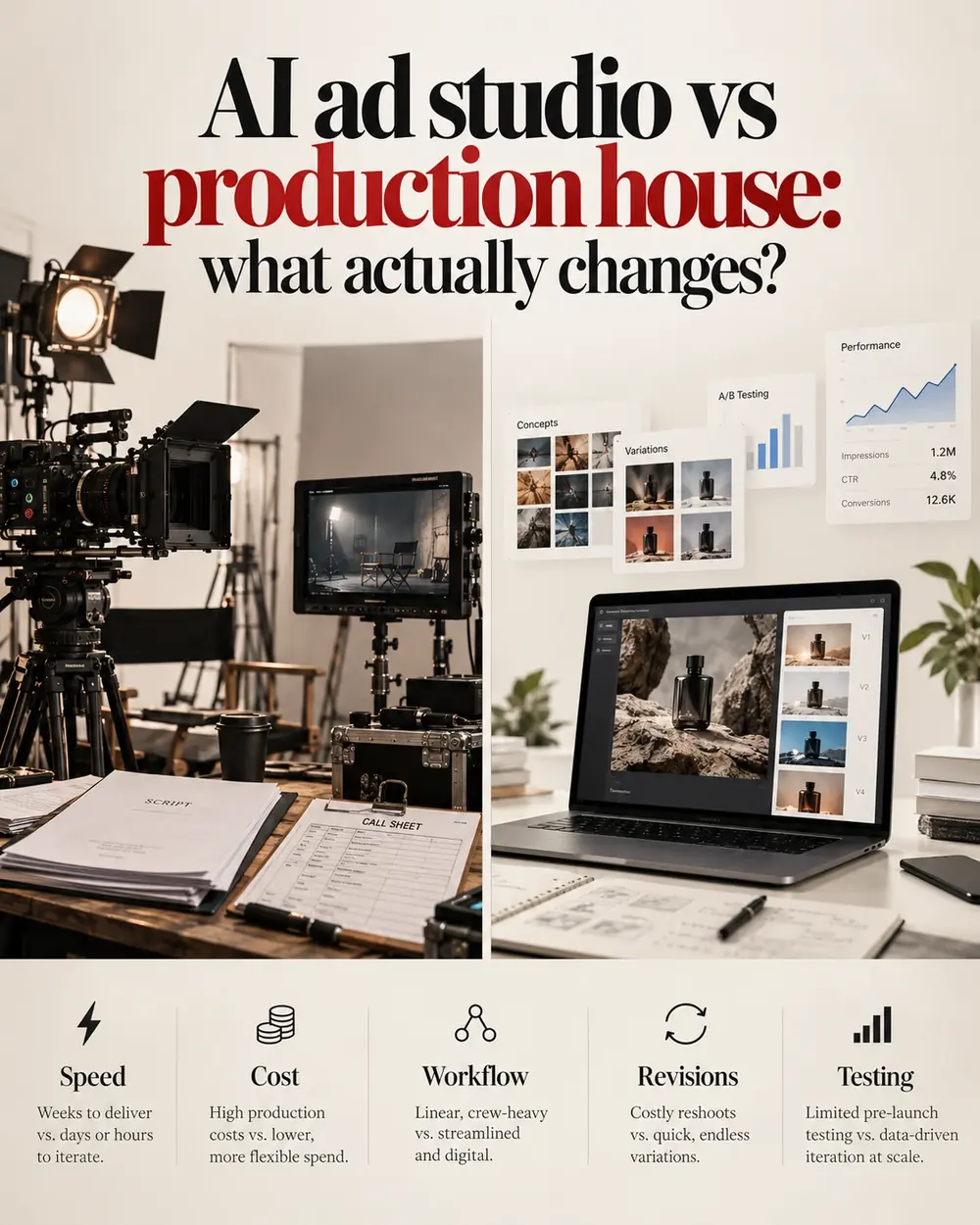
Less than the marketing on either side suggests. An AI ad studio and a production house do the same creative work. What changes is how the pictures get made, and that one change moves a lot of money around.
This is our honest version of the comparison, including the briefs we’d send to a production house ourselves.
What is an AI ad studio?
An AI ad studio is a production company that makes video ads with generative AI instead of cameras, sets and crews, while keeping the scriptwriting, direction, editing, colour grading and sound design of a traditional production. The method of capture changes. The craft that decides whether an ad works stays where it was.
What stays exactly the same?
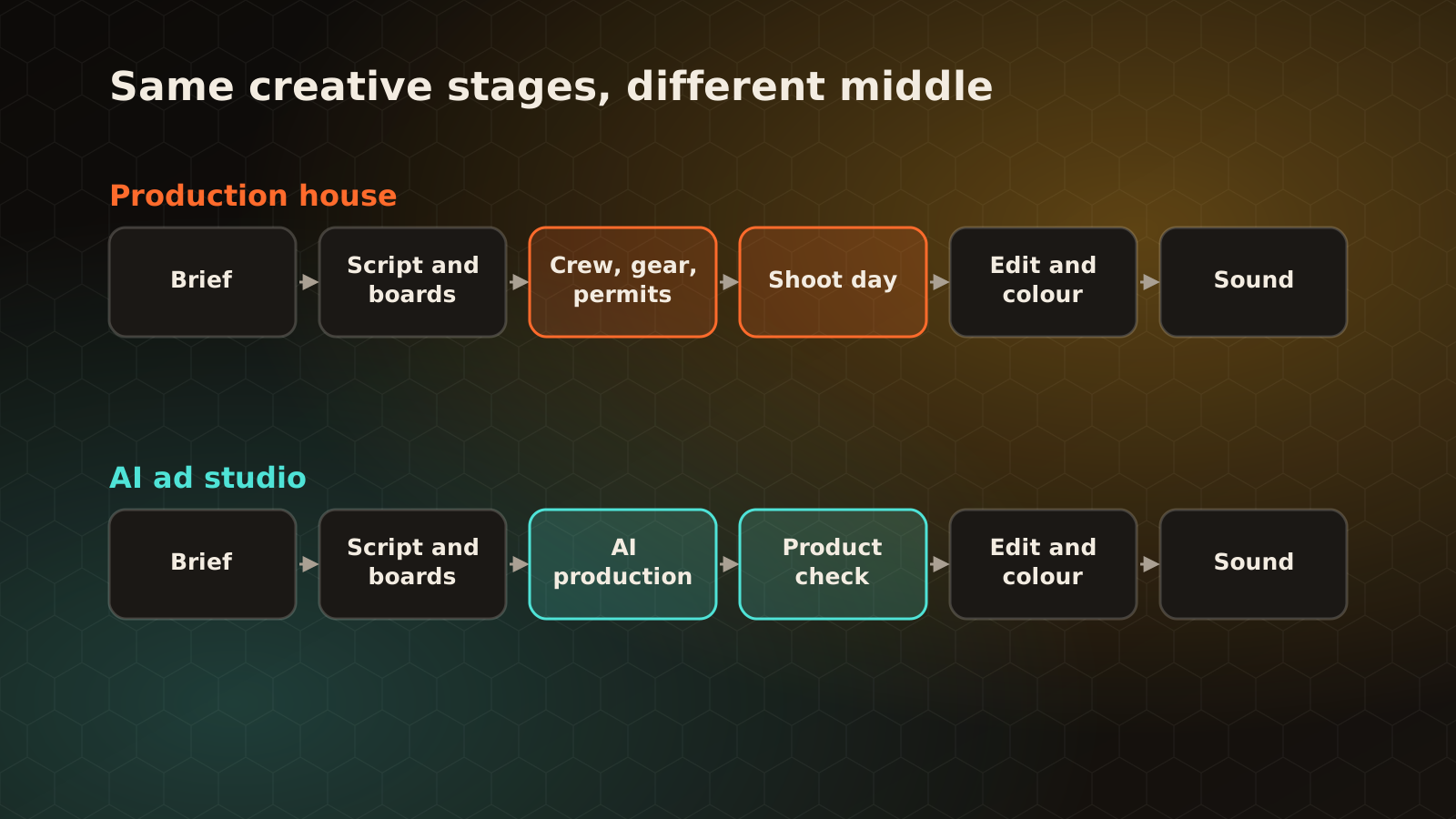
Every stage that decides whether an ad works is unchanged.
- The brief. Goal, audience, product truth, channel, format and deadline still have to be pinned down first.
- Script and boards. A script, pacing, camera directions and style frames, approved on paper before anything is produced.
- Edit and colour. Cutting, pacing and grading are still human decisions.
- Sound. Music, sound design and voiceover still have to be made and mixed.
If a studio skips these, the problem isn’t AI. The problem is that nobody is doing the job.
What genuinely changes?
There’s no shoot day
No location permit, crew call, camera rental, travel or catering. It’s the single biggest practical difference, and it’s where much of the saving comes from.
Trying another idea costs less
Changing a camera move later doesn’t mean booking the set again. Testing three hooks against each other becomes a scheduling question instead of a budget meeting.
Physical limits relax
A tracking shot along a coast road at speed, a slow-motion pour, a desert at golden hour: none of them need a racetrack, a high-speed rig or a flight. Our Lamborghini Revuelto film was made in three days with no car on set.
Consistency becomes the hard problem
A real camera never forgets what your packaging looks like. A generative model can. Labels drift, bottles change shape, a face changes between shots. That’s the real technical risk of the method, and it’s why every shot with your product in it gets checked against your artwork before delivery.
Where does the budget go in each?
In a conventional shoot, a big share of the money is spent before a single creative decision reaches the screen: equipment, crew, locations, permits, travel, food. Those line items buy capability, not ideas.
In an AI studio that layer is gone, so a larger share of a smaller budget goes to direction, motion and sound. The saving is real, but it isn’t magic and it isn’t unlimited. If you want numbers, our prices are published and this guide breaks them down.
| Production house | AI ad studio | |
|---|---|---|
| Script and storyboard | Yes | Yes |
| Crew, gear, locations, permits | Yes, often the biggest line | None |
| Changing a shot after production | Often a reshoot | Usually a regeneration |
| Real people and real places | Filmed as they are | Generated, never a fake testimonial |
| Biggest technical risk | Weather, logistics, schedules | Keeping the product consistent |
When is a production house still the right call?
We’d rather say this plainly than win the wrong brief. Book a shoot when:
- A specific real person must appear. A founder, a real customer or a contracted celebrity should be filmed as themselves.
- It’s a live event. A launch, a match or a wedding as it happens has nothing to generate.
- The appeal is physical and happens in real time. Food being handled, fabric being stretched, a demonstration someone might want to verify.
- The location is the claim. If the ad says “this is our factory”, the footage has to be of your factory.
- A regulator needs proof. Some categories and platforms require evidence that the footage shows a real product in real use.
Do the two ever meet?
All the time, and more each year. Conventional shoots already use generated set extensions and clean-up. AI-led work already uses real product photography and recorded voices.
So the useful question isn’t which camp a studio belongs to. It’s whether the creative stages are done properly, and whether the method suits your brief.
How does our process run?
Brief, script and shot list, production, post, delivery. The approval gate sits before production: nothing is generated until you’ve signed off the script. That one rule keeps the schedule and the price predictable.
For how the two routes compare across a whole campaign, on time, cost and results, read AI ads vs traditional ads in India. See how our process applies to product ads, commercial ads and storytelling ads, or send us a brief and we’ll tell you honestly which approach fits.
Frequently asked questions
What is the difference between an AI studio and a production house?
A production house films with cameras, crews and locations. An AI ad studio produces the pictures with generative AI and skips the shoot day. Both write scripts, direct, edit, grade and design sound.
Is AI video good enough for brand ads?
For product, commercial and story-led ads on Meta and YouTube, yes, provided the studio plans every shot and checks the product against its real artwork. It is not the right tool when a real person or a real place has to appear.
When should I choose a live shoot instead of AI?
Choose a shoot when a specific real person must appear, when you are covering a live event, when food or a physical demonstration has to be handled on camera, or when the footage must prove a real location.

About the author
Surya is a filmmaker and creative technologist and the founder of Spilanth Studio, an AI ads studio in Chennai that makes product, commercial and storytelling ads for brands across India. More about the studio.