Method
Honey Badger Marketing in practice: how we find the one feeling behind an ad
Every ad we make starts with one question: what does the customer feel just before they buy? Here is how that question turns into a script, a shot list and five ads.

Start with the feeling, not the product. Honey Badger Marketing is how we do that on every job: we dig for the one emotion that makes a customer want the thing, write a single ad around it, and then make five versions so the market can tell us which feeling wins.
This post walks through it with one made-up product, so you can see how a brief becomes an ad. For the short definition, see our page on Honey Badger Marketing.
What is the honey in an ad?
The honey is the feeling underneath the purchase. Nobody buys a hatchback for its boot space. They buy the pride of parking it outside their parents’ house for the first time.
Ads that find that feeling get watched. Ads that skip it get scrolled, however good the lighting is. The badger is the other half: the stubborn, structured part that goes after the honey with one angle per ad and the patience to read the numbers afterwards.
How do we find it? Brief to the bone
We dig before we draw. What does the product really do, who buys it, and what do they feel in the minute before they buy?
Take a ragi snack bar sold to office workers in Chennai. The product truth is simple: it’s filling, and it doesn’t taste like a diet. The human truth takes more digging. The buyer isn’t hungry at 4 pm. They’re tired of feeling guilty about the vending machine.
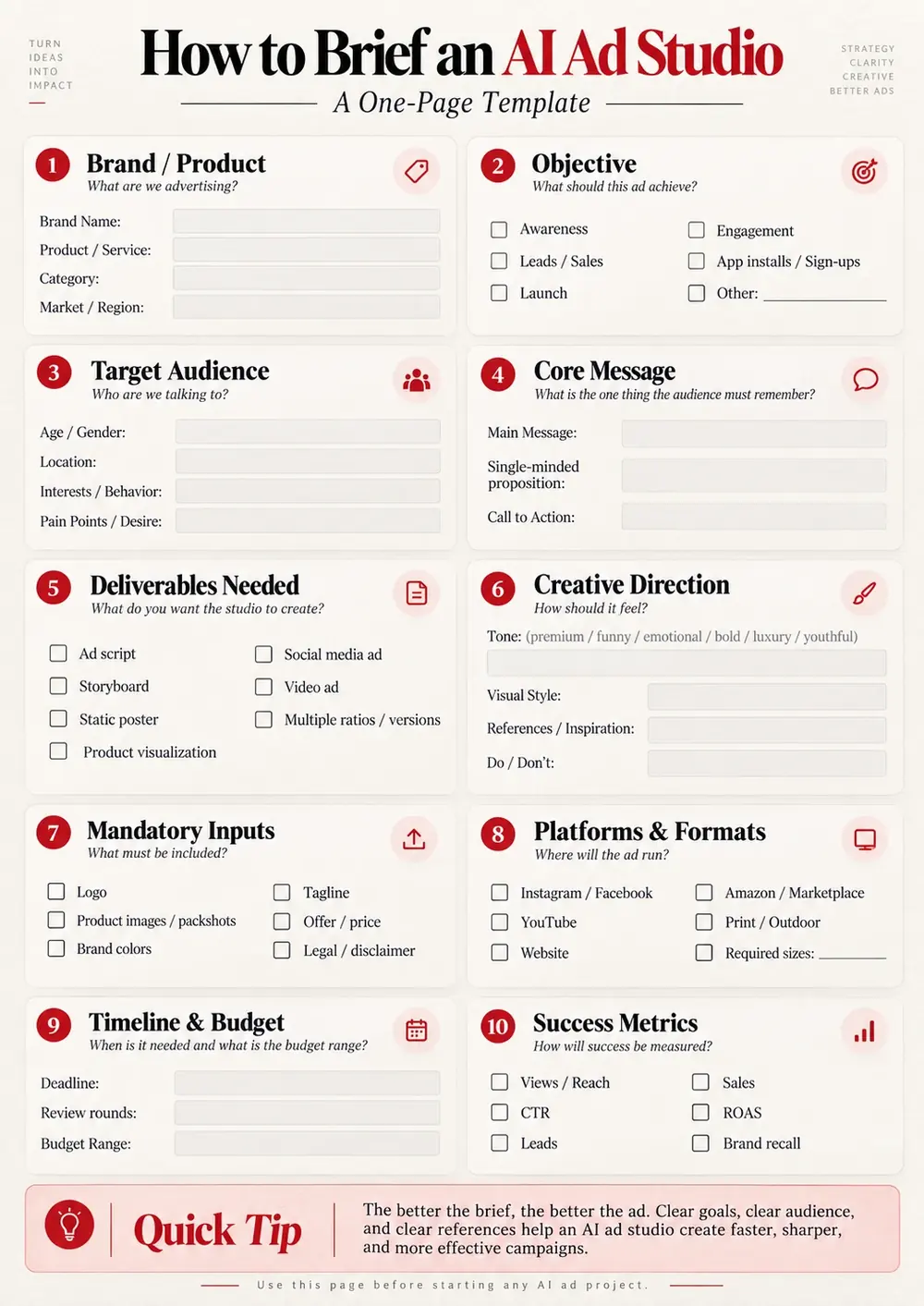
Both lines go on one page before any script exists. If we can’t write them in a sentence each, we haven’t dug far enough, and we ask you more questions. A good brief makes this step quick.
Why one angle per ad?
Because a thirty-second ad can carry one idea, and a second idea weakens the first. Five messages land as none.
For the snack bar, the angles might be relief (no more guilt), craving (the first crunch), belonging (the desk drawer everyone raids), pride (a better choice, made quietly) and proof (what is in it, shown plainly). Each one becomes its own ad. The product, the offer and the price stay exactly the same.
That last part matters. If you change the angle and the offer together, you can’t tell which one moved the result.
How does a script turn into an ad?
Script first, then a shot list, then production. AI is the camera and the direction stays human. A filmmaker decides where the light falls and what the first frame is, and your product is checked against its real artwork in every shot, so the pack on screen is the pack on the shelf.
You approve the script and the fixed price before anything is made. Nothing is produced on a guess. You can see how that works for product videos or look at what each ad costs.
What does Meta need from the ad?
The feed has its own rules, and we build to them from the first frame. That means 9:16 for Reels and Stories, 4:5 for Feed, captions for people watching with the sound off, and the hook inside the first three seconds.
A beautiful ad that opens slowly gets scrolled before it begins. So the craving ad opens on the crunch, not on the logo.
How do you tell which angle won?
Run the five ads side by side with the same budget and the same audience. Then let Ads Manager answer: how many people watch past the first seconds, and what each result costs.
Don’t decide in the first hour. Let each ad collect enough views to mean something. Our guide to why we sell ads in packs of five covers what to compare and what to ignore.
When one angle clearly pulls ahead, build the next pack around it: new hooks, same emotional truth. Bring the numbers back and we write the next five from them.
What isn’t Honey Badger Marketing?
Three things, and we say them up front.
- It isn’t media buying. We make the ads. Your team or your agency runs the budget and the targeting.
- It isn’t a promise of going viral. What it gives you is five real attempts instead of one guess.
- It isn’t five copies of one ad. A pack that only swaps the music tests nothing. The angle changes; the offer stays still.
If you have a product and a feeling you suspect is behind it, send us a brief and we’ll tell you what we’d test first.
Frequently asked questions
What is the honey in Honey Badger Marketing?
The honey is the feeling underneath a purchase, such as the pride of a first car or the relief of a quick dinner. Honey Badger Marketing starts by finding that feeling, because an ad that names it gets watched and an ad that skips it gets scrolled.
Why does each Spilanth Studio ad carry only one angle?
Five messages in thirty seconds land as none. One emotional angle per ad keeps the story clear, and it makes a pack of five a real test, because each ad changes the angle while the offer stays still.
Does Honey Badger Marketing promise a viral ad?
No. No honest studio can promise that. What the method gives you is five real attempts instead of one guess, and the numbers to see which angle your buyers respond to.
Do you run the ads on Meta for us?
No. We make the ads and cut them for Meta Reels, Feed and Stories. Your team or your agency runs the budget and the targeting.

About the author
Surya is a filmmaker and creative technologist and the founder of Spilanth Studio, an AI ads studio in Chennai that makes product, commercial and storytelling ads for brands across India. More about the studio.