Craft
Tamil ads that don't sound translated: writing AI ads for Tamil Nadu
A Tamil ad written in English and translated reads like a bank notice. Here's how we write ads that sound the way Tamil Nadu actually talks.
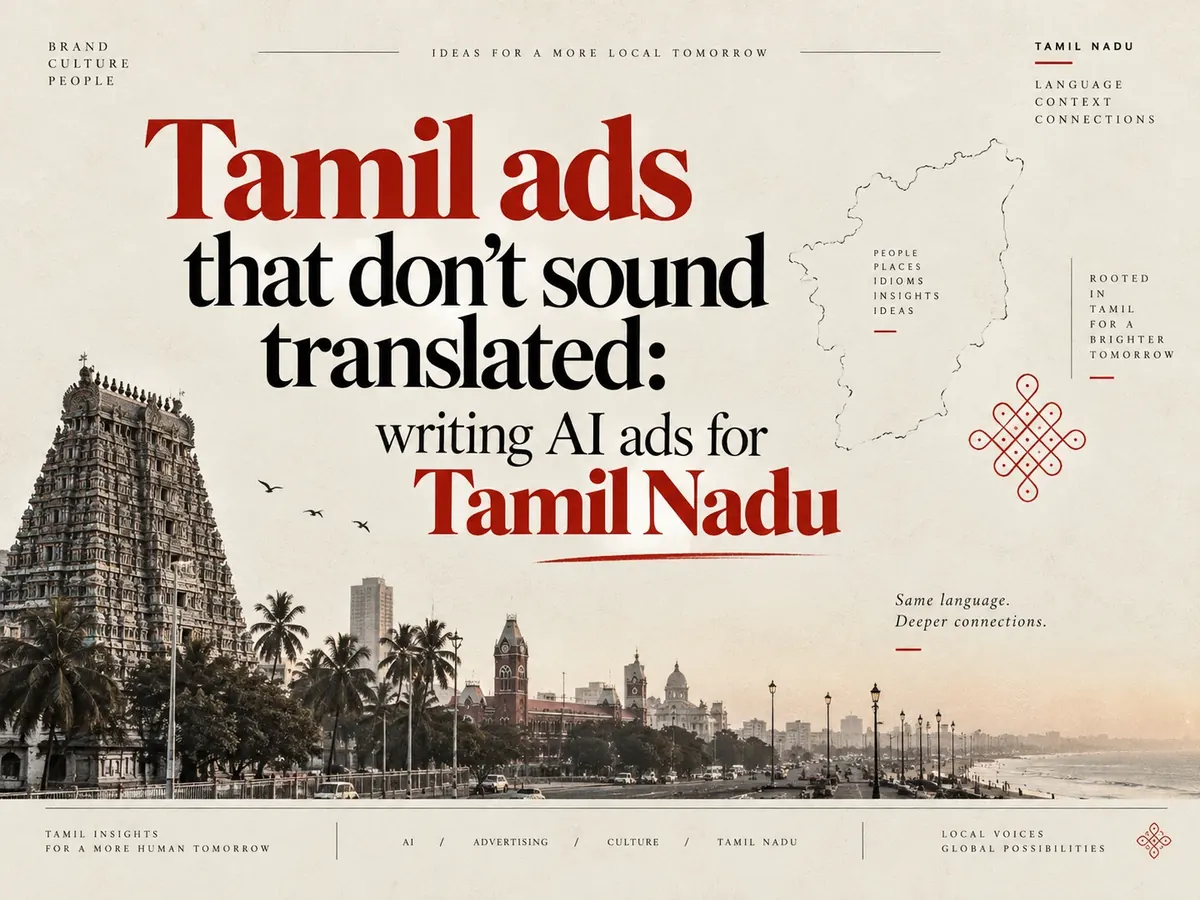
You can hear a translated ad within two seconds. The words are correct and the grammar is fine, but nobody talks like that. It sounds like a bank notice read out at a railway station.
It happens because the ad was written in English first, approved in English, and translated at the end. The Tamil version inherits English sentence rhythm, English jokes and English ideas of what’s persuasive. For a brand selling in Tamil Nadu, that throws away the one advantage a Tamil ad has: sounding like home.
Here’s how we write ads that don’t sound translated.
Why do translated Tamil ads fall flat?
Translated ads fall flat because persuasion lives in rhythm, idiom and register, and none of those survive translation intact. A punchy four-word English line can become a long, formal Tamil sentence that nobody would say out loud. Jokes built on English wordplay simply vanish. And the default register of translation, careful and formal, is the register of official announcements, not of people who might buy your snack.
Which Tamil should the ad speak?
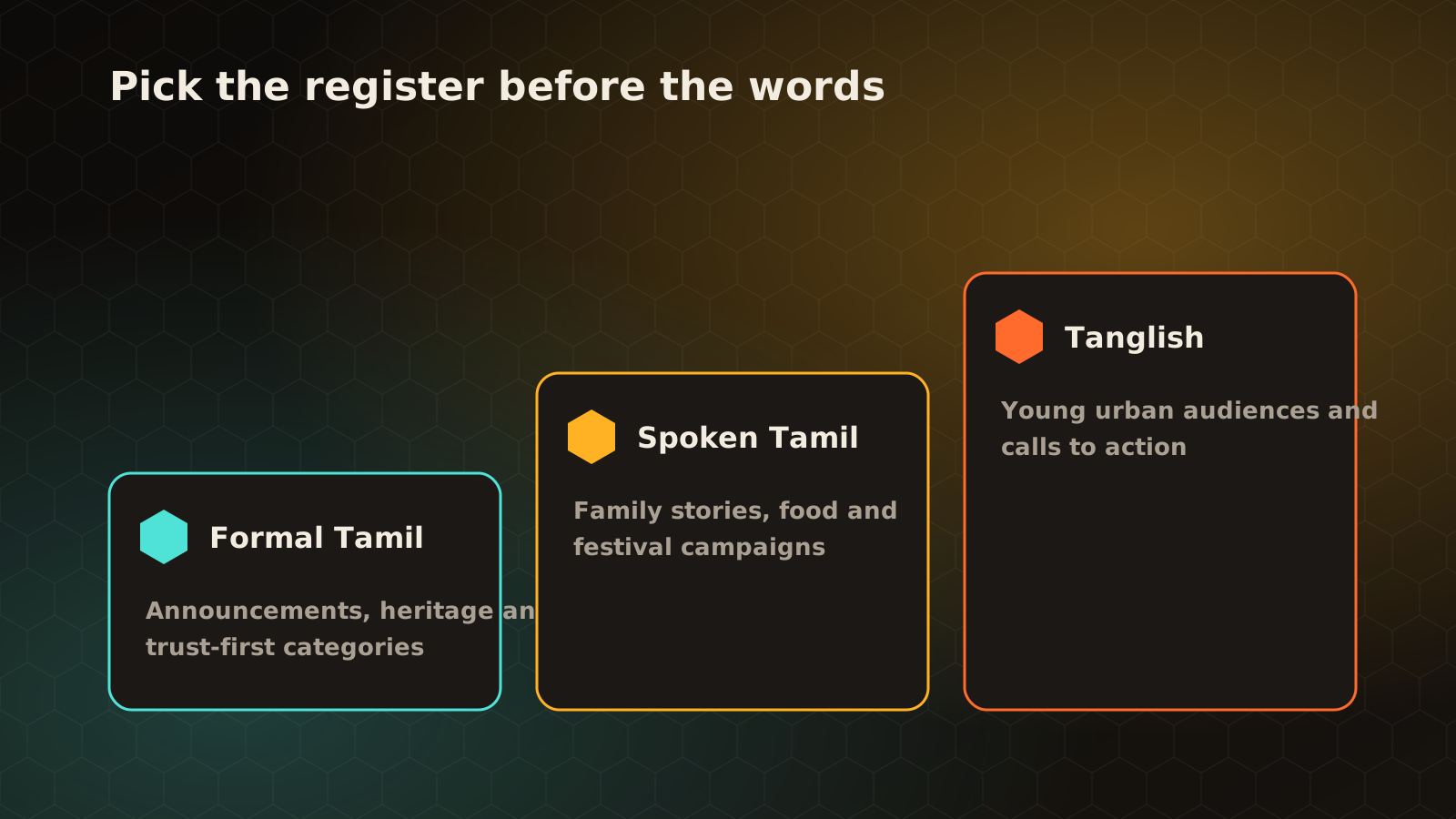
Pick the register before you write a single word. Tamil in ads usually lands in one of three places:
- Formal Tamil suits announcements, heritage brands and categories where trust comes first, such as jewellery, finance and healthcare.
- Everyday spoken Tamil suits family stories, food and festival campaigns. It’s how people actually talk at home.
- Tanglish, the Tamil and English mix you hear all over Chennai, suits young urban audiences and calls to action. “Order pannunga” often lands harder than “Order now”.
Here is one idea, a grandmother’s ragi snack now sold in a packet, in all three registers.
| Register | The line | What it says |
|---|---|---|
| Formal Tamil | பாரம்பரிய ராகி சுவை, இப்போது உங்கள் இல்லத்தில். | Traditional ragi taste, now in your home. |
| Everyday spoken Tamil | பாட்டி செஞ்ச ராகி, இப்போ பாக்கெட்டுல. | Grandma’s ragi, now in a packet. |
| Tanglish | இன்னிக்கே order பண்ணுங்க. | Order today. |
These are sample lines for an imaginary brand. Have a native speaker read any line before it runs.
Spoken Tamil also varies across the state. Chennai Tamil, Kongu Tamil around Coimbatore and Madurai Tamil each have their own flavour, and using one on purpose is a strong signal to that audience. Using one by accident, in an ad meant for the whole state, can feel like an in-joke nobody else gets.
Should you write in Tamil or translate from English?
Write in Tamil. Agree the idea in whichever language the team thinks in, but write the script itself in Tamil from the first draft. The brief can be English. The words people hear shouldn’t be.
Two practical rules help:
- Approve the Tamil script, not an English “version” of it. If the decision-maker doesn’t read Tamil, have someone read it aloud to them. Tone survives that. Translation doesn’t.
- Keep English only where Tamil Nadu keeps it. Brand names, “offer”, “delivery”, “combo”: people already say these in English. Forcing a pure-Tamil word where everyone uses the English one sounds odd.
How long should a Tamil voiceover be?
Time the voiceover out loud instead of counting words. Tamil is an agglutinative language, which means grammar is carried by suffixes stacked onto words, so Tamil words run long and a word count tells you very little about how long a line takes to say.
A 30-second ad has room for less speech than most people expect, in any language. Read every line aloud against the edit before recording, and cut until the pace feels relaxed. A rushed voiceover is the second most common sign of a translated ad, right after the formal register.
How should Tamil text appear on screen?
On-screen text matters more than ever because so many people watch with the sound off. Three things go wrong often:
- Broken letters. Tamil script combines consonants and vowel signs, and some fonts and editing tools render those combinations badly. Check every caption on a real phone before delivery.
- Too much text. Long Tamil words make lines wrap quickly. Keep captions to short phrases and let the pictures carry the rest.
- Captions in the wrong place. In Reels and Stories, keep text clear of the top and bottom of the screen, where Instagram puts names and buttons.
How do you use culture without clichés?
Use culture as the setting, not the joke. A Pongal ad doesn’t need a kolam in every frame. One kolam drawn at dawn, in the right light, says more. Aadi sales, Karthigai Deepam, a filter coffee davara-tumbler on the kitchen counter, the Kasimedu fish market at 5 am: the more specific and true the detail, the more the audience feels seen.
The other side of this is respect. Festivals, temples and deities carry real meaning for your buyers, so handle them with care, and check anything you’re unsure of with someone who knows.
Can you test Tamil and English against each other?
Yes, and it’s one of the most useful tests a Tamil Nadu brand can run. Make a pack of five with the same offer and use two of the ads to try a different language or register: the same craving hook in spoken Tamil and in Tanglish, say, next to an English version. Let the numbers tell you which one your buyers prefer. The method is in why we sell AI ads in packs of five.
We write and produce ads in Tamil, Telugu, Hindi and English, with each script written in its own language from the start. Planning a Tamil campaign? Send us the brief and tell us who you’re talking to.
Frequently asked questions
Can AI ads be made in Tamil?
Yes. Spilanth Studio writes and produces AI ads in Tamil, Telugu, Hindi and English, with the script, voiceover and on-screen text written in each language rather than translated.
Should Tamil ads use Tanglish?
Tanglish works well for young urban audiences and calls to action. Formal Tamil suits heritage and trust-first categories, and everyday spoken Tamil suits family, food and festival campaigns.
Why do translated ads sound wrong?
Because rhythm, idiom and register do not survive translation. Writing the script in Tamil from the first draft avoids the formal, announcement-style tone of translated copy.
Sources
- Tamil language, Wikipedia

About the author
Surya is a filmmaker and creative technologist and the founder of Spilanth Studio, an AI ads studio in Chennai that makes product, commercial and storytelling ads for brands across India. More about the studio.